About Me

I am a Ph.D. student in Digital Innovation and e-Health (started in October 2026) at the University of Bari Aldo Moro, conducting research within the Computational Intelligence Laboratory (CILAB) at the Department of Computer Science.

My research is centered around Artificial Intelligence for Digital Mental Health (DMH). Traditional psychiatric and clinical assessments still rely predominantly on episodic visits and standardized psychometric questionnaires, providing only an incomplete, episodic snapshot of an individual's mental state. Digital Mental Health opens the transformative opportunity for continuous, ecologically valid monitoring via wearable sensors and digital technologies capable of acquiring physiological, behavioral, acoustic, and contextual biomarkers.

While AI offers tremendous promise for analyzing these heterogeneous, high-dimensional streams, its real-world clinical adoption faces major obstacles. My doctoral research is dedicated to addressing these through three core methodological pillars:

1. Learning under Limited Labeled Data

Overcoming clinical annotation scarcity through benchmarked comparative analyses of self-supervised learning (SSL), semi-supervised learning, transfer learning, and modern foundation models on physiological time-series (e.g. HRV, EDA).

2. Multimodal Learning & Sensor Fusion

Investigating the distinct predictive contributions of multiple data modalities (physiological, acoustic, behavioral, contextual) and formulating advanced multimodal fusion architectures capable of handling asynchronous and heterogeneous data flows.

3. Explainable & Trustworthy AI (XAI)

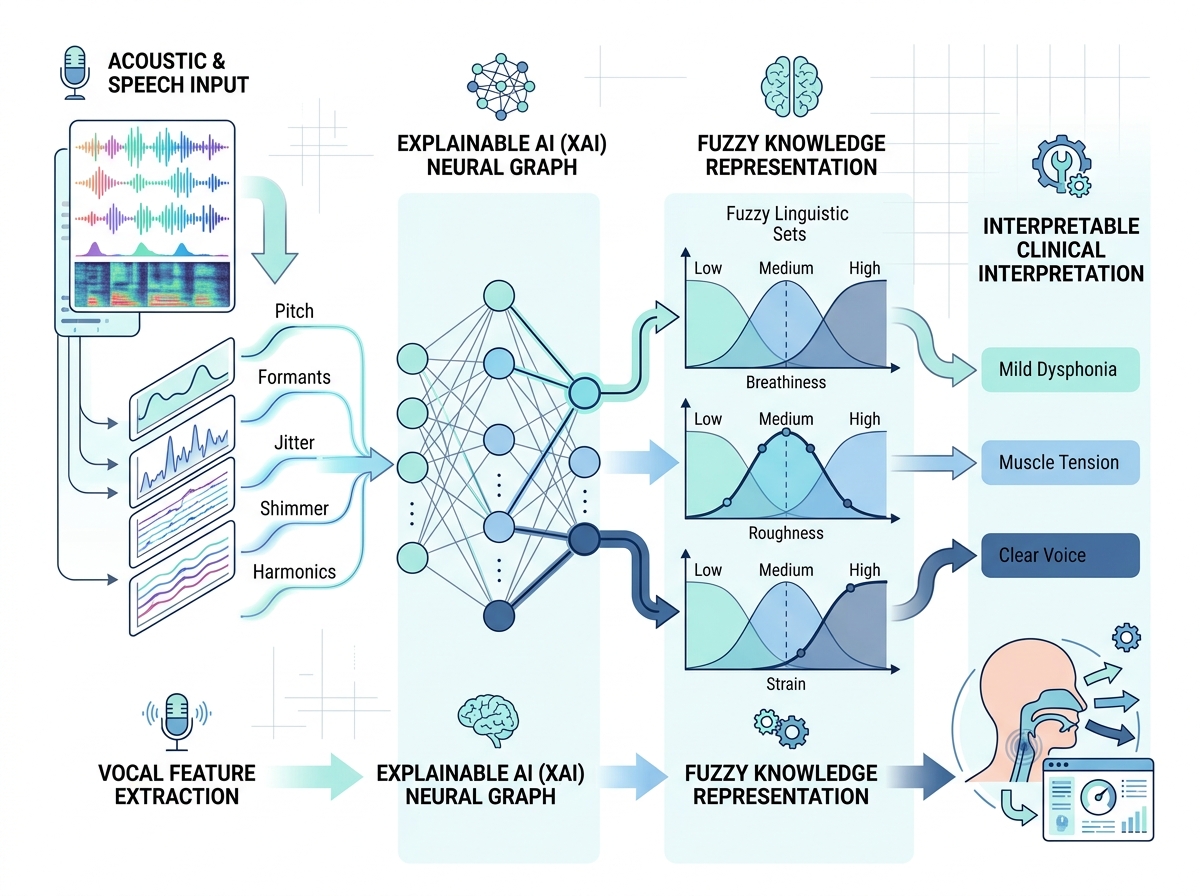
Bridging the black-box gap by comparing post-hoc explainability techniques (LIME, SHAP, counterfactuals) with intrinsically interpretable models (such as fuzzy linguistic representations), validated through human-centered studies involving clinical specialists.

The overarching goal is to formulate a unified methodological framework for designing reliable, robust, and transparent AI systems for continuous mental health monitoring, advancing their translation into clinical practice.

Research Interests & Focus

Digital Mental Health (DMH) Explainable AI (XAI) Fuzzy Linguistic Models Acoustic & Vocal Biomarkers Physiological Biosignals (HRV, EDA) Multimodal Sensor Fusion Self-Supervised Learning (SSL) Trustworthy & Human-in-the-Loop AI

Publications

Parkinson Fuzzy Linguistic Representation
AIPHEA @ IEEE WCCI 2026
Explaining Unsupervised Acoustic Patterns in Parkinson’s Patients’ Speech through Fuzzy Linguistic Representations
Gabriella Casalino, Giovanna Castellano, Maria Creanza*, Katarzyna Kaczmarek-Majer, Gianluca Zaza
1st Workshop on AI in Predictive HEAltH: architectures for prevention (AIPHEA 2026), co-located with 2026 IEEE World Congress on Computational Intelligence (IEEE WCCI 2026), Maastricht, The Netherlands, June 21-26, 2026. CEUR Workshop Proceedings (to appear).
Abstract: Speech-based analysis is a powerful tool for investigating Parkinson's disease, yet unsupervised representations often lack interpretability in medical settings. This paper presents an interpretable unsupervised framework combining Non-Negative Matrix Factorization (NMF) with fuzzy linguistic modeling. By translating latent acoustic factors and sample contributions into perceptual linguistic concepts, the framework provides transparent, multi-level explanations (latent factors, clusters, and individual speech recordings) without enforcing rigid class boundaries.
@inproceedings{casalino2026explaining, title = {Explaining Unsupervised Acoustic Patterns in Parkinson's Patients' Speech through Fuzzy Linguistic Representations}, author = {Casalino, Gabriella and Castellano, Giovanna and Creanza, Maria and Kaczmarek-Majer, Katarzyna and Zaza, Gianluca}, booktitle = {Proceedings of the 1st Workshop on AI in Predictive HEAltH: Architectures for Prevention (AIPHEA 2026) co-located with IEEE WCCI 2026}, series = {CEUR Workshop Proceedings}, year = {2026}, address = {Maastricht, The Netherlands} }

Education & Theses

Ph.D. in Digital Innovation and e-Health
Oct 2026 – Present
University of Bari Aldo Moro, Italy
Research Project: Digital Mental Health Monitoring via Explainable Artificial Intelligence
Affiliated with the Computational Intelligence Laboratory (CILAB).
M.Sc. in Computer Science (Artificial Intelligence track)
University of Bari Aldo Moro, Italy
Graduated: July 2026
Master's Thesis: Study and Implementation of Machine Learning Techniques for Mental Health Monitoring and Assessment

Investigated Self-Supervised Learning (SSL) and modern sequence models (Transformers, State Space Models) for continuous stress detection and mood monitoring using wearable biosignal time-series (HRV, EDA) and Explainable AI.

B.Sc. in Computer Science and Software Technologies (ITPS)
Informatica e Tecnologie per la Produzione del Software • University of Bari Aldo Moro, Italy
Graduated: October 2024
Bachelor's Thesis: Applicazione di Modelli di Vision Transformer per la Predizione dell'Anemia su Dataset Eterogenei

Designed a non-invasive screening pipeline using Vision Transformers (ViT) on palpebral conjunctiva photography across heterogeneous international cohorts, achieving 82% accuracy in binary anemia classification.

News & Updates

October 2026
Officially started my Ph.D. program in Digital Innovation and e-Health at the University of Bari Aldo Moro!
July 2026
Graduated with an M.Sc. in Computer Science (Artificial Intelligence track) from the University of Bari Aldo Moro.
July 2026
Our paper "Explaining Unsupervised Acoustic Patterns in Parkinson’s Patients’ Speech through Fuzzy Linguistic Representations" has been accepted for presentation at AIPHEA 2026 (co-located with IEEE WCCI 2026) in Maastricht, The Netherlands, and will appear in the CEUR Workshop Proceedings!